Labels

Showing posts with label Blog Notifications. Show all posts

Monday, 13 October 2014

POSTPONEMENT OF MID'S AND EXTERNAL EXAMINATIONS TIMETABLE

HI JNTUHCEM STUDENTS..

THIS IS THE LATEST INFORMATION REGARDING THE POSTPONEMENT OF MID-II , INTERNAL/EXTERNAL LABS AND END SEMESTER EXAMINATIONS..............

AND THE REVISED ACADEMIC CALENDER AS FOLLOWS.....

.

.

.

.

.

.

.

.

.

.
II MID EXAMINATIONS -->  17-NOV-2014 TO  22-NOV-2014

PREPARATION AND PRACTICAL EXAMINATIONS--> 24-NOV-2014 TO 29-NOV-2014

END SEMESTER EXAMINATIONS--> 01-DEC-2014 TO 13-DEC-2014

SUPPLE EXAMINATIONS--> 15-DEC-2014 TO 27-DEC-2014

Why LED Lights Won the Nobel Prize

The 2014 Nobel Prize in physics was awarded to Isamu Akasaki, Hiroshi Amano and Shuji Nakamura — three scientists who helped develop blue light-emitting diodes, or LEDs, in the early 1990s.

So why did the Nobel committee think LED lights are such a big deal? In part, they said, because of the technology's potential to change the world: "The LED lamp holds great promise for increasing the quality of life for over 1.5 billion people around the world who lack access to electricity grids: due to low power requirements it can be powered by cheap local solar power."

One big virtue of LEDs is that they're roughly 15 times more efficient than regular bulbs — and they keep improving at a remarkable clip. If they continue to get cheaper, they could replace fluorescents and incandescent lights in places like the United States and Europe, potentially cutting down on a major source of energy use and helping to tackle global warming (although it's also possible that, if lighting gets more efficient, we could just end up using more of it).

So how important are LEDs, really? Here's an overview:

A short history of LEDs

LEDs are often viewed as the next generation of lighting technology. First we had fire. Then gaslight in the 19th century. Then Thomas Edison developed his filament bulbs. More recently, we've had the fluorescent and compact fluorescent bulbs most people now have in their offices and homes.
Those innovations all helped us get more and more lighting with less and less energy. The cost of providing a given amount of light has dropped 3,000-fold since the early 1800s.

Now LEDs look more promising still, since they use less energy and don't contain harmful mercury, like fluorescent bulbs do. But it wasn't always obvious that LEDs would be the next step. Back in the 1980s, diodes could still only emit red or green light, which isn't very handy for lighting a room. But in the 1990s, Nakamura helped develop the first high-brightness blue LED — building on the work of Akasaki and Amano in Japan. Now it was conceivable that LEDs could be used for everyday purposes.
Since then, LEDs have advanced further and become used for an array of different sources. They're in streetlights and traffic lights. They're used for displays in computers and smartphones. But the big, idealistic hope is that they could help bring light to the 1.5 billion people who don't have it.

How LEDs could help light up the developing world

It's worth remembering that there are about 1.2 billion people in the world who still lack access to electricity. And many people who do have electricity barely have enough power for reliable lighting.


As a result, many households still burn either wood or gas for lighting. Not only is that inefficient, but the resulting indoor air pollution is killing millions and millions of people. Plus there are all sorts of knock-on effects — it's much harder for kids to study for school if they can't even read their books.

Now enter LEDs. One big thing these lights have going for them is efficiency. Incandescent lightbulbs are extremely inefficient — it takes a lot of energy to heat up the filament inside, and only a fraction (2 percent or so) of that energy is given off as light. LEDs do considerably better. Engineers can now get about 300 lumens of light from the most advanced LED bulbs for every Watt of electrical power used — compared to just 70 lumens from a compact fluorescent bulb and just 16 for a filament bulb.

In other words, LEDs are about 4 times as efficient as CFLs and 15 times as efficient as filament bulbs. As Charles Kenny explained in Foreign Policy, those low energy demands for LEDs mean that many households that aren't currently connected to the grid could use solar panels and small batteries to power LED lights.

The biggest obstacle is cost: LEDs often have a higher upfront price tag than other types of light bulbs. But that price has been steadily falling over time, to the point where we could start to see wider adoption in poorer countries. (The other advantages? LEDs last longer than compact fluorescent bulbs, they don't break as easily, and they don't contain mercury — so they're easier to dispose.)

Could LEDs help tackle global warming?

The other big potential application for LEDs is in the developed world. It's worth remembering that lighting is a massive source of energy use — it makes up about 17 percent of US electricity consumption.
In theory, LEDs could help change that. Most plans to boost energy efficiency and reduce greenhouse-gas emissions in the United States and Europe envision LEDs replacing all existing lighting technologies by 2050 or so. (See, for instance, this recent UN report on "deep decarbonization.")

The one hitch, however, is what's known as the "rebound effect." Historically, as lighting has gotten cheaper, we've used more and more of it — so that overall energy use for lighting has actually gone up, not down. That's one big consideration here. LEDs could well bolster lighting efficiency and leave us all better off. But it's not guaranteed that energy use — and greenhouse-gas emissions — will go down as a result.

Update: See also my colleague Tim Lee's post on the amazing efficiency progress that LEDs have made over the years. It includes this chart:

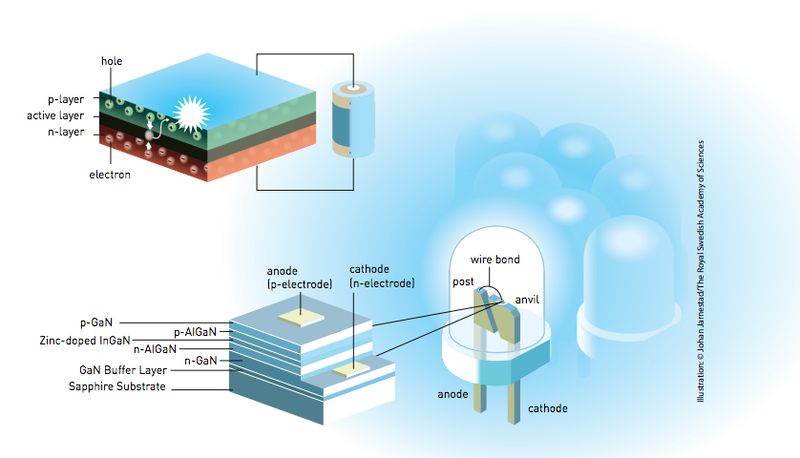
THE INVENTORS OF EFFICIENT BLUE LED'S..

SOURCE : a paper from the university of wisconsin

Thank You friends... FoR rEaDiNg My ArTiCle - Bharath Kumar Goud


Saturday, 11 October 2014

Kailash Satyarthi and Malala Yousafzai Win the Nobel Peace Prize

 During the three decades he has worked to free thousands of children laboring in dank mines and factories throughout India, Kailash Satyarthi has been shoved, kicked, threatened with deadly weapons and beaten numerous times.

His family hoped that he would cut back on child-trafficking raids when he turned 60, but just last month he directed the rescue of 23 children from a tiny basement factory in New Delhi. On Friday, the longtime advocate was sitting behind a desk at his small office in the capital when he learned from a journalist’s telephone call that he had won the Nobel Peace Prize. Satyarthi, the first Indian-born recipient of the honor, will share the award with Malala Yousafzai, the young Pakistani who became an education activist after the Taliban shot her on her way to school.


Satyarthi said it was a “great honor” and a “happy moment” for India, as well as for the children he had long worked to save. In a brief interview, he called for the “globalization of human compassion.”

“I am quite hopeful that this will help in giving greater visibility to the cause of children who are the most neglected and most deprived, and that this will also inspire the individuals, activists, governments, business houses and [corporations] to work hand-in-hand to fight it out,” he said. “The recognition of this issue will help in mobilizing bigger support for the cause.”

News of the award set off a raucous celebration at Satyarthi’s Bachpan Bachao Andolan (Save the Childhood Movement) office and a ripple of national pride throughout India.


“Who is Malala?” shouted the Taliban gunman who leapt onto a crowded bus in northwestern Pakistan two years ago, then fired a bullet into the head of Malala Yousafzai, a 15-year-old schoolgirl and outspoken activist.

That question has been answered many times since by Ms. Yousafzai herself, who survived her injuries and went on to become an impassioned advocate, global celebrity and, on Friday, the latest recipient of the Nobel Peace Prize alongside the Indian child rights campaigner Kailash Satyarthi.
Yet since that decisive gunshot in October 2012, Ms. Yousafzai and her compelling story have been reshaped by a range of powerful forces — often, though not always, for good — in ways that have left her straddling perilous fault lines of culture, politics and religion.

In Pakistan, conservatives assailed the schoolgirl as an unwitting pawn in an American-led assault. In the West, she came to embody the excesses of violent Islam, or was recruited by campaigners to raise money and awareness for their causes. Ms. Yousafzai, guided by her father and a public relations team, helped to transform that image herself, co-writing a best-selling memoir.


And now the Nobel Prize committee has provided a fresh twist on her story, recasting her as an envoy for South Asian peace.

Announcing the prize in Oslo on Friday, the committee chairman, Thorbjorn Jagland, said it was important for “a Hindu and a Muslim, an Indian and a Pakistani, to join in a common struggle for education and against extremism” — a resonant message in a week in which the Pakistani and Indian armies have exchanged shellfire across a disputed stretch of border, killing 20 villagers. But it was also a message that highlighted how far Ms. Yousafzai has come from her original incarnation as the schoolgirl who defied the Taliban and lived to tell the tale.

Thursday, 9 October 2014

SAFETY AND SECURITY ENGINEERING (S.A.S.E) 2K14 - U.G Conference

UG CONFERENCE, SASE-2K14
NATIONAL LEVEL TECHNICAL UNDER GRADUATE CONFERENCE-2K14
SAFETY AND SECURITY ENGINEERING (S.A.S.E)
The One Day National Level Technical Under Graduate Conference-2K14 on SAFETY AND SECURITY ENGINEERING (S.A.S.E) is conducted and organized be the SAC, JNTUHCEM under the Guidance of Administrative SAC Dr. R. Markandeya and Executive SAC Dr. Kaujala Prasanna Lakshmi. It is held on 29th October 2014, at JNTUH College of Engineering Manthani with Dr. Kaujala Prasanna Lakshmi as its Convener and all the SAC Board of Directors acting as its coordinators. This conference is organized to emphasize the innovative views and intellectual ideas of undergraduate college students on the cited areas of interest and thereby help them to gain the knowledge of prime importance. This would help students get experience of we can secure safety in the field of engineering regardless of the discipline.

All B.E and B.Tech students are invited to attend the Conference.


Having a conference means having opportunity to:
- Meet engineering students from other colleges,
- Become familiar with study and faculty in a hosting country (curriculum, faculty
equipment and possibilities for research work, first hand information about
student exchange possibilities, local and national student organization and their
projects, sport and casual events etc.),
- Promote your association inside and outside your faculty,
- Gain connections, build networks with institutions important to your association’s
work,
- Bring new active students into your association,
- Get to know the history and beauties of the new technologies in engineering,
- Travel,
- Gain new life experiences,
- Train your management skills,
- Gain new friendship,
- And a lot of other reasons, professional and personal.

Topics for the Conference:
Topic and Conference Name: Safety And Security Engineering (S.A.S.E) - 2014
Topics are being like:


Risk analysis, assessment and management,
System safety engineering,
Incident management,
Information and communication security,
Natural disaster management, Emergency response,
Critical infrastructure protection, Public safety and security,
Human factors,
Transportation safety and security,
Modelling and experiments,
Security surveillance systems,
Cyber securities,
Other topics related to Safety And Security Engineering are also accepted
We have selected the topic such that students from all the branches of Engineering can present their papers

Code of Conduct: 

Only B.E and B.Tech Students (only) of all years are allowed to present their papers at the Conference.
This One Day National Level Technical Under Graduate Conference-2K14 on SAFETY AND SECURITY ENGINEERING (S.A.S.E) is conducted for 7-8 Hours.
All the papers should present their papers in IEEE format.
All the Papers must be send with the title "SAFETY AND SECURITY ENGINEERING (S.A.S.E)".
All the Papers should be submitted within  or on 21st of October and information regarding the selected papers for the conference will be sent to the participants email address on 25th October.
The maximum number of students is restricted to 80-100.
Students are encouraged to write their own papers instead of dumping information from Wikipedia . Students must provide necessary reference links to the data they provide.
Each student is given a time span of about 10-15 mins to present his papers and the topic of choice should be only in English.
College doesn't provide any accommodation for outside students who are willing to participate.
No usage of vulgar slang, the topic of choice must be spoken only in ENGLISH.
  

Wednesday, 1 October 2014

Monday, 29 September 2014

First year Results.................... R13

hi friends ,
first year R13 regular results released
links for results
SERVER 1-  http://122.252.228.141:8282/JNTUHResults/PortalGUI/Results/StudentResult.aspx?result=73
SERVER 2- http://202.63.105.206:8585/JNTUHResults/PortalGUI/Results/StudentResult.aspx?result=73

And Last Date For Recounting/Revaluation is 06-10-2014

Saturday, 27 September 2014

May the beauty of this auspicious and nature friendly festival fill your home with happiness and may the coming year provide you with all that brings you joy! Happy Bathukamma


Yes, We have to give moral support to our friends


WELCOME TO THE ULTIMATE JNTUHCEM BLOG


hi friends welcome to the first blog of jntuhcem................


Am soo excited about using this new communications tool and hope it will increase our collaboration and interaction among us. The blog is intended to serve as a vehicle for informing latest news of our college, giving timetables of exams schedule etc, giving assistance to fest's project works, raising awareness about latest tech news, and – most importantly – giving me an opportunity to hear from you.

P. Bharath Kumar,
+91 77 949 12345
+91 87 120 120 20
pbkgoud@outlook.com