Showing posts with label EEE. Show all posts

Monday, 13 October 2014

Why LED Lights Won the Nobel Prize

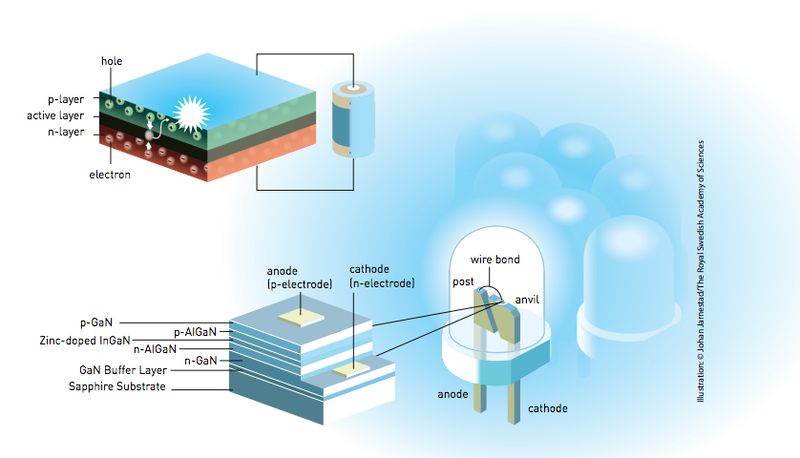
The 2014 Nobel Prize in physics was awarded to Isamu Akasaki, Hiroshi Amano and Shuji Nakamura — three scientists who helped develop blue light-emitting diodes, or LEDs, in the early 1990s.

So why did the Nobel committee think LED lights are such a big deal? In part, they said, because of the technology's potential to change the world: "The LED lamp holds great promise for increasing the quality of life for over 1.5 billion people around the world who lack access to electricity grids: due to low power requirements it can be powered by cheap local solar power."

One big virtue of LEDs is that they're roughly 15 times more efficient than regular bulbs — and they keep improving at a remarkable clip. If they continue to get cheaper, they could replace fluorescents and incandescent lights in places like the United States and Europe, potentially cutting down on a major source of energy use and helping to tackle global warming (although it's also possible that, if lighting gets more efficient, we could just end up using more of it).

So how important are LEDs, really? Here's an overview:

A short history of LEDs
LEDs are often viewed as the next generation of lighting technology. First we had fire. Then gaslight in the 19th century. Then Thomas Edison developed his filament bulbs. More recently, we've had the fluorescent and compact fluorescent bulbs most people now have in their offices and homes.
Those innovations all helped us get more and more lighting with less and less energy. The cost of providing a given amount of light has dropped 3,000-fold since the early 1800s.

Now LEDs look more promising still, since they use less energy and don't contain harmful mercury, like fluorescent bulbs do. But it wasn't always obvious that LEDs would be the next step. Back in the 1980s, diodes could still only emit red or green light, which isn't very handy for lighting a room. But in the 1990s, Nakamura helped develop the first high-brightness blue LED — building on the work of Akasaki and Amano in Japan. Now it was conceivable that LEDs could be used for everyday purposes.
Since then, LEDs have advanced further and become used for an array of different sources. They're in streetlights and traffic lights. They're used for displays in computers and smartphones. But the big, idealistic hope is that they could help bring light to the 1.5 billion people who don't have it.

How LEDs could help light up the developing world

It's worth remembering that there are about 1.2 billion people in the world who still lack access to electricity. And many people who do have electricity barely have enough power for reliable lighting.


As a result, many households still burn either wood or gas for lighting. Not only is that inefficient, but the resulting indoor air pollution is killing millions and millions of people. Plus there are all sorts of knock-on effects — it's much harder for kids to study for school if they can't even read their books.

Now enter LEDs. One big thing these lights have going for them is efficiency. Incandescent lightbulbs are extremely inefficient — it takes a lot of energy to heat up the filament inside, and only a fraction (2 percent or so) of that energy is given off as light. LEDs do considerably better. Engineers can now get about 300 lumens of light from the most advanced LED bulbs for every Watt of electrical power used — compared to just 70 lumens from a compact fluorescent bulb and just 16 for a filament bulb.

In other words, LEDs are about 4 times as efficient as CFLs and 15 times as efficient as filament bulbs. As Charles Kenny explained in Foreign Policy, those low energy demands for LEDs mean that many households that aren't currently connected to the grid could use solar panels and small batteries to power LED lights.

The biggest obstacle is cost: LEDs often have a higher upfront price tag than other types of light bulbs. But that price has been steadily falling over time, to the point where we could start to see wider adoption in poorer countries. (The other advantages? LEDs last longer than compact fluorescent bulbs, they don't break as easily, and they don't contain mercury — so they're easier to dispose.)

Could LEDs help tackle global warming?

The other big potential application for LEDs is in the developed world. It's worth remembering that lighting is a massive source of energy use — it makes up about 17 percent of US electricity consumption.
In theory, LEDs could help change that. Most plans to boost energy efficiency and reduce greenhouse-gas emissions in the United States and Europe envision LEDs replacing all existing lighting technologies by 2050 or so. (See, for instance, this recent UN report on "deep decarbonization.")

The one hitch, however, is what's known as the "rebound effect." Historically, as lighting has gotten cheaper, we've used more and more of it — so that overall energy use for lighting has actually gone up, not down. That's one big consideration here. LEDs could well bolster lighting efficiency and leave us all better off. But it's not guaranteed that energy use — and greenhouse-gas emissions — will go down as a result.

Update: See also my colleague Tim Lee's post on the amazing efficiency progress that LEDs have made over the years. It includes this chart:

THE INVENTORS OF EFFICIENT BLUE LED'S..

SOURCE : a paper from the university of wisconsin

Thank You friends... FoR rEaDiNg My ArTiCle - Bharath Kumar Goud


Monday, 29 September 2014

Low-cost, “green” transistor heralds advance in flexible electronics

As tech company LG demonstrated this summer with the unveiling of its 18-inch flexible screen, the next generation of roll-up displays is tantalizingly close. Researchers are now reporting in the journal ACS Nano a new, inexpensive and simple way to make transparent, flexible transistors—the building blocks of electronics—that could help bring roll-up smartphones with see-through displays and other bendable gadgets to consumers in just a few years.

Yang Yang and colleagues note that transistors are traditionally made in a multi-step photolithography process, which uses light to print a pattern onto a glass or wafer. Not only is this approach costly, it also involves a number of toxic substances. Finding a greener, less-expensive alternative has been a challenge. Recently, new processing techniques using metal oxide semiconductors have attracted attention, but the resulting devices are lacking in flexibility or other essential traits. Yang’s team wanted to address these challenges.

The researchers developed inks that create patterns on ultrathin, transparent devices when exposed to light. This light sensitivity precludes the need for harsh substances or high temperatures. “The main application of our transistors is for next-generation displays, like OLED or LCD displays,” said Yang. “Our transistors are designed for simple manufacturing. We believe this is an important step toward making flexible electronics widely accessible.”

Nanotechnology leads to better, cheaper LEDs for phones and lighting

Princeton Univ. researchers have developed a new method to increase the brightness, efficiency and clarity of LEDs, which are widely used on smartphones and portable electronics as well as becoming increasingly common in lighting.

Using a new nanoscale structure, the researchers, led by electrical engineering professor Stephen Chou, increased the brightness and efficiency of LEDs made of organic materials (flexible carbon-based sheets) by 57%. The researchers also report their method should yield similar improvements in LEDs made in inorganic (silicon-based) materials used most commonly today.
A nanotechnology structure called PlaCSH (plasmonic cavity with subwavelength hole-array) has allowed an increase in efficiency of light extraction to 60%, which is 57% higher than conventional high-end organic LEDs. Images: Princeton Univ.

The method also improves the picture clarity of LED displays by 400%, compared with conventional approaches. In an article published online August 19 in the journal Advanced Functional Materials, the researchers describe how they accomplished this by inventing a technique that manipulates light on a scale smaller than a single wavelength.
"New nanotechnology can change the rules of the ways we manipulate light," said Chou, who has been working in the field for 30 years. "We can use this to make devices with unprecedented performance."
A LED, or light emitting diode, is an electronic device that emits light when electrical current moves through two terminals. LEDs offer several advantages over incandescent or fluorescent lights: they are far more efficient, compact and have a longer lifetime, all of which are important in portable displays.
Current LEDs have design challenges; foremost among them is to reduce the amount of light that gets trapped inside the LED's structure. Although they are known for their efficiency, only a very small amount of light generated inside an LED actually escapes.
A PlaCSH in operation.A PlaCSH in operation."It is exactly the same reason that lighting installed inside a swimming pool seems dim from outsidebecause the water traps the light," said Chou, the Joseph C. Elgin Professor of Engineering. "The solid structure of a LED traps far more light than the pool's water."
In fact, a rudimentary LED emits only about 2 to 4% of the light it generates. The trapped light not only makes the LEDs dim and energy inefficient, it also makes them short-lived because the trapped light heats the LED, which greatly reduces its lifespan.
"A holy grail in today's LED manufacturing is light extraction," Chou said.
Engineers have been working on this problem. By adding metal reflectors, lenses or other structures, they can increase the light extraction of LEDs. For conventional high-end, organic LEDs, these techniques can increase light extraction to about 38%. But these light-extraction techniques cause the display to reflect ambient light, which reduces contrast and makes the image seem hazy.
To combat the reflection of ambient light, engineers now add light-absorbing materials to the display. But Chou said such materials also absorb the light from the LED, reducing its brightness and efficiency by as much as half.
The solution presented by Chou's team is the invention of a nanotechnology structure called PlaCSH (plasmonic cavity with subwavelength hole-array). The researchers reported that PlaCSH increased the efficiency of light extraction to 60%, which is 57% higher than conventional high-end organic LEDs. At the same time, the researchers reported that PlaCSH increased the contrast (clarity in ambient light) by 400%. The higher brightness also relieves the heating problem caused by the light trapped in standard LEDs.
Chou said that PlaCSH is able to achieve these results because its nanometer-scale, metallic structures are able to manipulate light in a way that bulk material or non-metallic nanostructures cannot.
Chou first used the PlaCSH structure on solar cells, which convert light to electricity. In a 2012 paper, he described how the application of PlaCSH resulted in the absorption of as much as 96 percent of the light striking solar cells' surface and increased the cells' efficiency by 175 percent. Chou realized that a device that was good at absorbing light from the outside could also be good at radiating light generated inside the device—offering an efficient solution for both light extraction and the reduction of light reflection.
The basic structure of a PlaCSH LED.The basic structure of a PlaCSH LED."From a view point of physics, a good light absorber, which we had for the solar cells, should also be a good light radiator," he said. "We wanted to experimentally demonstrate this is true in visible light range, and then use it to solve the key challenges in LEDs and displays."
The physics behind PlaCSH are complex, but the structure is relatively simple. PlaCSH has a layer of light-emitting material about 100 nm thick that is placed inside a cavity with one surface made of a thin metal film. The other cavity surface is made of a metal mesh with incredibly small dimensions: it is 15 nm thick; and each wire is about 20 nm in width and 200 nanometers apart from center to center. (A nanometer is one hundred-thousandth the width of a human hair.)
Because PlaCSH works by guiding the light out of the LED, it is able to focus more of the light toward the viewer. The system also replaces the conventional brittle transparent electrode, making it far more flexible than most current displays.
"It is so flexible and ductile that it can be weaved into a cloth," Chou said.
Another benefit for manufacturers is cost. The PlaCSH organic LEDs were made by nanoimprint, a technology Chou invented in 1995, which creates nanostructures in a fashion similar to a printing press producing newspapers.
"It is cheap and extremely simple," Chou said.
Princeton has filed patent applications for both organic and inorganic LEDs using PlaCSH. Chou and his team are now conducting experiments to demonstrate PLaCSH in red and blue organic LEDs, in addition the green LEDs used in the current experiments. They also are demonstrating the system in inorganic LEDs.
Besides Chou, the paper's authors are Wei Ding, Yuxuan Wang and Hao Chen, graduate students in electrical engineering at Princeton. Support for the research was provided in part by the Defense Advanced Research Projects Agency and the Office of Naval Research.  Chou recently was awarded a major grant from the U.S. Department of Energy to further advance the use of PlaCSH as a solution for energy-efficient lighting.

Sunday, 28 September 2014

Wireless Power Transmission - A Next Generation Power Transmission System

The technology for wireless power transmission or wireless power transfer (WPT) is in the forefront of electronic development. Applications involving microwaves, solar cells, lasers, and resonance of electromagnetic waves have had the most recent success with WPT.  The main function of wireless power transfer is to allow electrical devices to be continuously charged and lose the constraint of a power cord.  Although the idea is only a theory and not widely implemented yet, extensive research dating back to the 1850’s has led to the conclusion that WPT is possible. Wireless Power Transmission, Transfer
The three main systems used for WPT are microwaves, resonance, and solar cells. Microwaves would be used to send electromagnetic radiation from a power source to a receiver in an electrical device.


The concept of resonance causes electromagnetic radiation at certain frequencies to cause an object to vibrate.  This vibration can allow energy to be transmitted between the two vibrating sources.  Solar cells, ideally, would use a satellite in space to capture the suns energy and send the energy back to Earth.  This concept would help to solve the major energy crisis currently concerning most of the world.  These ideas would work perfectly in theory, but converting the radio frequencies into electrical power and electrical power to radio frequencies are two main problems that are withholding this idea to become reality. This paper will explore the technological applications of microwaves, resonance, and solar cells in WPT and explain the basic technique of  transmitting power wirelessly. It will also include problems encountered during experimentation and recent advances in the field. The paper will also include the futuristic applications of WPT and its ability to solve the energy crisis.

The Beginning Of Wireless Power Transmission
Electricity by today’s standards is considered an essential to life.  Electricity has been the fuel for technological development since its first applications dating back to the late 16th century.  This marvellous phenomenon, however, comes with a price.  The cost of making electricity is harmful to the environment. The Energy Information Administration’s records show that nearly 50% of all electrical plants are high polluting coal plants. Major changes in the environment have occurred over the last 30 years that are detrimental to the future of this planet.  If this path is left unchanged, scientists have predicted that certain parts of the world could be uninhabitable by 2050. The solution is to reduce greenhouse gas emissions into earth’s atmosphere through alternative power generation.  One sustainable technology leading this charge is wireless power transfer (WPT).


The concept of wireless power transmission has been around since the mid 17th century.  WPT is exactly what the name states; to transfer electrical power from a source to a device without the aid of wires.  The founder of AC electricity, Nikola Tesla, was first to conduct experiments dealing with WPT.  His initial experiment of lighting gas discharge lamps from over 25 miles away, wirelessly, was a success.  His idea came from the notion that earth itself is a conductor that can carry a charge throughout the entire surface. Although his idea of a world system of WPT could never be properly funded, his initial research sparked the scientific world into a whole new theory of power generation.  While Tesla’s experiments were not creating electricity, but just transferring it, his ideas can be applied to solve our energy crisis.  His experiments sparked new ideas such as applications involving microwaves, lasers, resonance and solar cells.  Each application has its respective drawbacks but also has the potential to aid this planet in its dying need for an alternative to creating power.

Today, portable technology is a part of every day life. Most commonly used devices no longer need to draw power from the supply continuously. But from portability emerges another challenge: energy. Almost all portable devices are battery powered, meaning that eventually, they all must be recharged–using the wired chargers currently being used. Now instead of plugging in a cell phone, PDA, digital camera, voice recorder, mp3 player or laptop to recharge it, it could receive its power wirelessly–quite literally, “out of thin air”.


Saturday, 27 September 2014

Flame-Shaping Electric Fields Could Make Power Plants Cleaner

ClearSign’s pollution-reducing technology could help power plants burn less fuel and make more money.
A Seattle company called ClearSign Combustionhas developed a trick that it says could nearly eliminate key pollutants from power plants and refineries, and make such installations much more efficient. The technique involves electric fields to control the combustion of fuel by manipulating the shape and brightness of flames.

The technology could offer a cheaper way to reduce pollution in poor countries. And because ClearSign’s approach to reducing pollution also reduces the amount of fuel a power plant consumes, it can pay for itself, the company says. The need for better pollution controls is clear now in China, where hazardous pollution has been shutting down schools and roads this week.
The company claims that its technology could reduce fuel consumption by as much as 30 percent. Some outside experts say that in practice the likely improvement would be far less, possibly only a few percent, although even that would still result in large savings.
Much of the pollution from a power plant is the result of problems with combustion. If parts of a flame get too hot, it can lead to the formation of nitrogen oxides, which contribute to smog. Similarly, incomplete burning, which can result from the poor mixing of fuel and air, can form soot (see “Cheaper, Cleaner Combustion”).
ClearSign uses high-voltage electric fields to manipulate the electrically charged molecules in a combustion flame. This can improve the way air and fuel mix together, and can spread out a flame to prevent hot spots that cause pollution.
The idea of using electricity to shape flames has been around for decades. But conventional approaches typically involve plasma, and the plasma needs large amounts of energy. ClearSign says its technology only uses one-tenth of 1 percent of the energy in the fuel that a power plant consumes. It works using electrodes within the flame. The electrode produces high voltages that influence the movement of ions; by varying the voltage, it’s possible to control the way the flame forms. The technology is particularly effective at reducing smog-forming NOx emissions, carbon monoxide, and soot.
“There’s been interest in electric fields for some time, but nothing with as strong an effect as they’ve demonstrated,” says Michael Frenklach, a professor of mechanical engineering at the University of California, Berkeley.
In addition to reducing pollution, the technology can improve the efficiency of a power plant or a refinery in several ways. Improved mixing of fuel and air means less fuel is wasted by incomplete combustion; the technology can also improve heat transfer from the flame to the water in a boiler, so less fuel is needed to make steam, which is used to drive turbines in a power plant. But the biggest potential for fuel savings could be in reducing or eliminating the need for conventional pollution controls, which can consume significant amounts of energy, and can be expensive.