Showing posts with label MECH. Show all posts

Monday, 13 October 2014

Why LED Lights Won the Nobel Prize

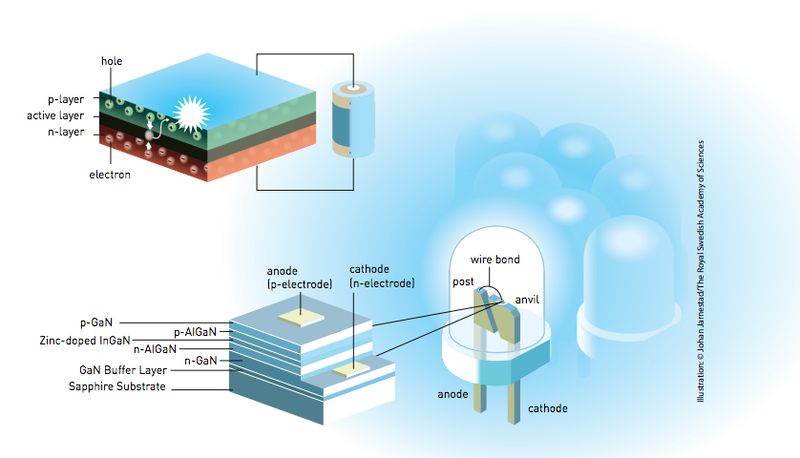
The 2014 Nobel Prize in physics was awarded to Isamu Akasaki, Hiroshi Amano and Shuji Nakamura — three scientists who helped develop blue light-emitting diodes, or LEDs, in the early 1990s.

So why did the Nobel committee think LED lights are such a big deal? In part, they said, because of the technology's potential to change the world: "The LED lamp holds great promise for increasing the quality of life for over 1.5 billion people around the world who lack access to electricity grids: due to low power requirements it can be powered by cheap local solar power."

One big virtue of LEDs is that they're roughly 15 times more efficient than regular bulbs — and they keep improving at a remarkable clip. If they continue to get cheaper, they could replace fluorescents and incandescent lights in places like the United States and Europe, potentially cutting down on a major source of energy use and helping to tackle global warming (although it's also possible that, if lighting gets more efficient, we could just end up using more of it).

So how important are LEDs, really? Here's an overview:

A short history of LEDs
LEDs are often viewed as the next generation of lighting technology. First we had fire. Then gaslight in the 19th century. Then Thomas Edison developed his filament bulbs. More recently, we've had the fluorescent and compact fluorescent bulbs most people now have in their offices and homes.
Those innovations all helped us get more and more lighting with less and less energy. The cost of providing a given amount of light has dropped 3,000-fold since the early 1800s.

Now LEDs look more promising still, since they use less energy and don't contain harmful mercury, like fluorescent bulbs do. But it wasn't always obvious that LEDs would be the next step. Back in the 1980s, diodes could still only emit red or green light, which isn't very handy for lighting a room. But in the 1990s, Nakamura helped develop the first high-brightness blue LED — building on the work of Akasaki and Amano in Japan. Now it was conceivable that LEDs could be used for everyday purposes.
Since then, LEDs have advanced further and become used for an array of different sources. They're in streetlights and traffic lights. They're used for displays in computers and smartphones. But the big, idealistic hope is that they could help bring light to the 1.5 billion people who don't have it.

How LEDs could help light up the developing world

It's worth remembering that there are about 1.2 billion people in the world who still lack access to electricity. And many people who do have electricity barely have enough power for reliable lighting.


As a result, many households still burn either wood or gas for lighting. Not only is that inefficient, but the resulting indoor air pollution is killing millions and millions of people. Plus there are all sorts of knock-on effects — it's much harder for kids to study for school if they can't even read their books.

Now enter LEDs. One big thing these lights have going for them is efficiency. Incandescent lightbulbs are extremely inefficient — it takes a lot of energy to heat up the filament inside, and only a fraction (2 percent or so) of that energy is given off as light. LEDs do considerably better. Engineers can now get about 300 lumens of light from the most advanced LED bulbs for every Watt of electrical power used — compared to just 70 lumens from a compact fluorescent bulb and just 16 for a filament bulb.

In other words, LEDs are about 4 times as efficient as CFLs and 15 times as efficient as filament bulbs. As Charles Kenny explained in Foreign Policy, those low energy demands for LEDs mean that many households that aren't currently connected to the grid could use solar panels and small batteries to power LED lights.

The biggest obstacle is cost: LEDs often have a higher upfront price tag than other types of light bulbs. But that price has been steadily falling over time, to the point where we could start to see wider adoption in poorer countries. (The other advantages? LEDs last longer than compact fluorescent bulbs, they don't break as easily, and they don't contain mercury — so they're easier to dispose.)

Could LEDs help tackle global warming?

The other big potential application for LEDs is in the developed world. It's worth remembering that lighting is a massive source of energy use — it makes up about 17 percent of US electricity consumption.
In theory, LEDs could help change that. Most plans to boost energy efficiency and reduce greenhouse-gas emissions in the United States and Europe envision LEDs replacing all existing lighting technologies by 2050 or so. (See, for instance, this recent UN report on "deep decarbonization.")

The one hitch, however, is what's known as the "rebound effect." Historically, as lighting has gotten cheaper, we've used more and more of it — so that overall energy use for lighting has actually gone up, not down. That's one big consideration here. LEDs could well bolster lighting efficiency and leave us all better off. But it's not guaranteed that energy use — and greenhouse-gas emissions — will go down as a result.

Update: See also my colleague Tim Lee's post on the amazing efficiency progress that LEDs have made over the years. It includes this chart:

THE INVENTORS OF EFFICIENT BLUE LED'S..

SOURCE : a paper from the university of wisconsin

Thank You friends... FoR rEaDiNg My ArTiCle - Bharath Kumar Goud


Sunday, 12 October 2014

WRIST WATCH , THE MECHANICAL GIANT- MOST COMPLEX MACHINE


36 complications, 25 of them visible, 1,483 components, a 1000-year calendar, a price tag of 2.7 million dollars, and 5 years’ work; 99 jewels... 
The glass sapphire case back enables the harmoniously chiselled and decorated pieces that overlap to be admired in a stunning combination as a dazzling ballet. This masterpiece of complications and know how was entirely designed and manufactured by the Franck Muller group and once again demonstrates their vast array of skills and ability in the Art of HAUTE HORLOGERIE. 

Reference: 8888 MGA T CCR QPSE 
Caliber: FM 3480 QPSE 
Movement Mechanic Tourbillon, Carillon Westminster on 4 hammers and 4 gongs, Chronograph with fly-back mechanism and only one push-piece, Perpetual Calendar Secular, Equation of time, Two additional time zones, Automatic self-winding mechnanism for the movement and the Westminster carillon. 


Sunday, 28 September 2014

Bucket wheel excavator


Bucket-wheel excavators (BWEs) are heavy equipment used in surface mining. The primary function of BWEs is to act as a continuous digging machine in large-scale open pit mining operations. What sets BWEs apart from other large-scale mining equipment, such as bucket chain excavators, is their use of a large wheel consisting of a continuous pattern of buckets used to scoop material as the wheel turns. They are among the largest vehicles ever constructed, and the biggest bucket-wheel excavator ever built, Bagger 293, is the largest terrestrial (land) vehicle in human history according to the Guinness Book of World Records.

A bucket wheel excavator (BWE) consists of a superstructure to which several more components are fixed.

The bucket wheel from which the machines get their name is a large, round wheel with a configuration of scoops which is fixed to a boom and is capable of rotating. Material picked up by the cutting wheel is transferred back along the boom. In early cell-type bucket wheels, the material was transferred through a chute leading from each bucket, while newer cell-less and semi-cell designs use a stationary chute through which all of the buckets discharge.

A discharge boom receives material through the superstructure from the cutting boom and carries it away from the machine, frequently to an external conveyor system.

A counterweight boom balances the cutting boom and is cantilevered either on the lower part of the superstructure (in the case of compact BWEs) or the upper part (in the case of mid-size C-frame BWEs). In the larger BWEs, all three booms are supported by cables running across towers at the top of the superstructure.

Beneath the superstructure lay the movement systems. On older models these would be rails for the machine to travel along, but newer BWEs are frequently equipped with crawlers, which grant them increased flexibility of motion.

To allow it to complete its duties, the superstructure of a BWE is capable of rotating about a vertical axis (slewing). The cutting boom can be tilted up and down (hoisting). The speeds of these operations are on the orders of 30 m/min and 5 m/min, respectively. Slewing is driven by large gears, while hoisting generally makes use of a cable system.


Saturday, 27 September 2014

HUMMINGBIRDS VS. HELICOPTERS: STANFORD ENGINEERS COMPARE FLIGHT DYNAMICS

A quantitative analysis of hummingbird wings shows that they generate lift more efficiently than the best microhelicopter blades. The findings could lead to more powerful, bird-inspired robotic vehicles.

More than 42 million years of natural selection have turned hummingbirds into some of the world's most energetically efficient flyers, particularly when it comes to hovering in place.
Humans, however, are gaining ground quickly. A new study led by David Lentink, an assistant professor of mechanical engineering at Stanford, reveals that the spinning blades of microhelicopters are about as efficient at hovering as the average hummingbird.
The experiment involved spinning hummingbird wings – sourced from a pre-existing museum collection – of 12 different species on an apparatus designed to test the aerodynamics of helicopter blades. The researchers used cameras to visualize airflow around the wings, and sensitive load cells to measure the drag and the lift force they exerted at different speeds and angles.
Lentink and his colleagues then replicated the experiment using the blades from a ProxDynamics Black Hornet autonomous microhelicopter. The Black Hornet is the most sophisticated microcopter available – the United Kingdom's army uses it in Afghanistan – and is about the size of a hummingbird.

Even spinning like a helicopter, rather than flapping, the hummingbird wings excelled: If hummingbirds were able to spin their wings to hover, it would cost them roughly half as much energy as flapping. The microcopter's wings kept pace with the middle-of-the-pack hummingbird wings, but the topflight wings – those of Anna's hummingbird, a species common throughout the West Coast – were still about 27 percent more efficient than engineered blades.
Hummingbirds acing the test didn't particularly surprise Lentink – previous studies had indicated that hummingbirds were incredibly efficient – but he was impressed with the helicopter.
"The technology is at the level of an average Joe hummingbird," Lentink said. "A helicopter is really the most efficient hovering device that we can build. The best hummingbirds are still better, but I think it's amazing that we're getting closer. It's not easy to match their performance, but if we build better wings with better shapes, we might approximate hummingbirds."
Based on the measurements of Anna's hummingbirds, Lentink said there is potential to improve microcopter rotor power by up to 27 percent.
The study is published in the current issue of Journal of the Royal Society: Interface.
The high-fidelity experiment also provided an opportunity to refine previous rough estimates of muscle power. Lentink's team learned that hummingbirds' muscles produce a surprising 130 watts of energy per kilogram; the average for other birds, and across most vertebrates, is roughly 100 watts per kilogram.
Although the current study revealed several details of how a hummingbird hovers in one place, the birds still hold many secrets. For instance, Lentink said, we don't know how hummingbirds maintain their flight in a strong gust, how they navigate through branches and other clutter or how they change direction so quickly during aerial "dogfights."
He also thinks great strides could be made by studying wing aspect ratios, the ratio of wing length to wing width. The aspect ratios of all the hummingbirds' wings remarkably converged at about 3.9. The aspect ratios of most wings used in aviation measure much higher; the Black Hornet's aspect ratio was 4.7.
"I want to understand if aspect ratio is special and whether the amount of variation has an effect on performance," Lentink said. Understanding and replicating these abilities and characteristics could be a boon for robotics and will be the focus of future experiments.
"Those are the things we don't know right now, and they could be incredibly useful. But I don't mind it, actually," Lentink said. "I think it's nice that there are still a few things about hummingbirds that we don't know."