Showing posts with label CSE. Show all posts

Monday, 13 October 2014

Why LED Lights Won the Nobel Prize

The 2014 Nobel Prize in physics was awarded to Isamu Akasaki, Hiroshi Amano and Shuji Nakamura — three scientists who helped develop blue light-emitting diodes, or LEDs, in the early 1990s.

So why did the Nobel committee think LED lights are such a big deal? In part, they said, because of the technology's potential to change the world: "The LED lamp holds great promise for increasing the quality of life for over 1.5 billion people around the world who lack access to electricity grids: due to low power requirements it can be powered by cheap local solar power."

One big virtue of LEDs is that they're roughly 15 times more efficient than regular bulbs — and they keep improving at a remarkable clip. If they continue to get cheaper, they could replace fluorescents and incandescent lights in places like the United States and Europe, potentially cutting down on a major source of energy use and helping to tackle global warming (although it's also possible that, if lighting gets more efficient, we could just end up using more of it).

So how important are LEDs, really? Here's an overview:

A short history of LEDs
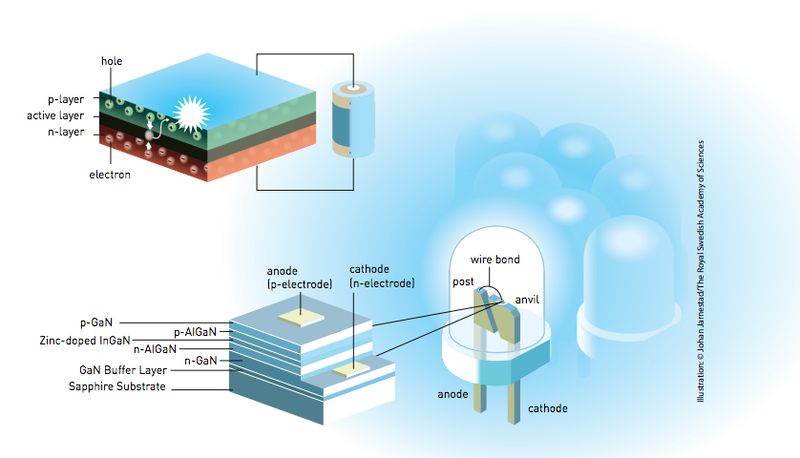
LEDs are often viewed as the next generation of lighting technology. First we had fire. Then gaslight in the 19th century. Then Thomas Edison developed his filament bulbs. More recently, we've had the fluorescent and compact fluorescent bulbs most people now have in their offices and homes.
Those innovations all helped us get more and more lighting with less and less energy. The cost of providing a given amount of light has dropped 3,000-fold since the early 1800s.

Now LEDs look more promising still, since they use less energy and don't contain harmful mercury, like fluorescent bulbs do. But it wasn't always obvious that LEDs would be the next step. Back in the 1980s, diodes could still only emit red or green light, which isn't very handy for lighting a room. But in the 1990s, Nakamura helped develop the first high-brightness blue LED — building on the work of Akasaki and Amano in Japan. Now it was conceivable that LEDs could be used for everyday purposes.
Since then, LEDs have advanced further and become used for an array of different sources. They're in streetlights and traffic lights. They're used for displays in computers and smartphones. But the big, idealistic hope is that they could help bring light to the 1.5 billion people who don't have it.

How LEDs could help light up the developing world

It's worth remembering that there are about 1.2 billion people in the world who still lack access to electricity. And many people who do have electricity barely have enough power for reliable lighting.


As a result, many households still burn either wood or gas for lighting. Not only is that inefficient, but the resulting indoor air pollution is killing millions and millions of people. Plus there are all sorts of knock-on effects — it's much harder for kids to study for school if they can't even read their books.

Now enter LEDs. One big thing these lights have going for them is efficiency. Incandescent lightbulbs are extremely inefficient — it takes a lot of energy to heat up the filament inside, and only a fraction (2 percent or so) of that energy is given off as light. LEDs do considerably better. Engineers can now get about 300 lumens of light from the most advanced LED bulbs for every Watt of electrical power used — compared to just 70 lumens from a compact fluorescent bulb and just 16 for a filament bulb.

In other words, LEDs are about 4 times as efficient as CFLs and 15 times as efficient as filament bulbs. As Charles Kenny explained in Foreign Policy, those low energy demands for LEDs mean that many households that aren't currently connected to the grid could use solar panels and small batteries to power LED lights.

The biggest obstacle is cost: LEDs often have a higher upfront price tag than other types of light bulbs. But that price has been steadily falling over time, to the point where we could start to see wider adoption in poorer countries. (The other advantages? LEDs last longer than compact fluorescent bulbs, they don't break as easily, and they don't contain mercury — so they're easier to dispose.)

Could LEDs help tackle global warming?

The other big potential application for LEDs is in the developed world. It's worth remembering that lighting is a massive source of energy use — it makes up about 17 percent of US electricity consumption.
In theory, LEDs could help change that. Most plans to boost energy efficiency and reduce greenhouse-gas emissions in the United States and Europe envision LEDs replacing all existing lighting technologies by 2050 or so. (See, for instance, this recent UN report on "deep decarbonization.")

The one hitch, however, is what's known as the "rebound effect." Historically, as lighting has gotten cheaper, we've used more and more of it — so that overall energy use for lighting has actually gone up, not down. That's one big consideration here. LEDs could well bolster lighting efficiency and leave us all better off. But it's not guaranteed that energy use — and greenhouse-gas emissions — will go down as a result.

Update: See also my colleague Tim Lee's post on the amazing efficiency progress that LEDs have made over the years. It includes this chart:

THE INVENTORS OF EFFICIENT BLUE LED'S..

SOURCE : a paper from the university of wisconsin

Thank You friends... FoR rEaDiNg My ArTiCle - Bharath Kumar Goud


Saturday, 27 September 2014

Flexible gadgets come closer to reality with carbon nanotubes

Flexible gadgets come closer to reality with carbon nanotubes
Semiconductor material carbon nanotubes (CNT) has brought flexible electronics closer to reality, which will improve the reliability and performance of transistors and circuits based on it.
 A new study has revealed that a semiconductor material carbon nanotubes (CNT) has brought flexible electronics closer to reality, which will improve the reliability and performance of transistors and circuits based on it.

Researchers at the University of Texas at Austin and Northwestern University examined the effect of a fluoropolymer coating calledpolyvinyledenedifluoride-tetrafluoroethylene(PVDF-TrFE) on single-walled carbon nanotube(SWCNT) transistors and ring oscillator circuits, and demonstrated that these coatings can substantially improve the performance of single-walled carbon nanotube devices.

Researcher AnanthDodabalapur said that they attributed the improvements to the polar nature of PVDF-TrFE that mitigates the negative effect of impurities and defects on the performance of semiconductor single-walled carbon nanotubes.

Co-author Mark Hersam said that the single-walled carbon nanotubefield-effect transistors (FETs) have characteristics similar to polycrystalline silicon FETs, a thin film silicon transistor currently used to drive the pixels in organic light-emitting (OLED) displays.

Hersam added that the single-walled carbon nanotubes are more advantageous than polycrystalline silicon in that they are solution-processable or printable, which potentially could lower manufacturing costs.

He continued that the mechanical flexibility of single-walled carbon nanotubes also should allow them to be incorporated into emerging applications such as flexible electronics and wearable electronics.

Yoga, meditation may help train brain to help people control computers with their mind


New research by biomedical engineers at the University of Minnesota shows that people who practice yoga and meditation long term can learn to control a computer with their minds faster and better than people with little or no yoga or meditation experience. The research could have major implications for treatments of people who are paralyzed or have neurodegenerative diseases.
The research is published online in TECHNOLOGY, a new scientific journal featuring cutting-edge new technologies in emerging fields of science and engineering.
In the study, researchers involved a total of 36 participants. One group of 12 had at least one year of experience in yoga or meditation at least two times per week for one hour. The second group included 24 healthy participants who had little or no yoga or meditation experience. Both groups were new to systems using the brain to control a computer. Both groups participated in three, two-hour experiments over four weeks in which they wore a high tech, non-invasive cap over the scalp that picked up brain activity. The participants were asked to move a computer cursor across the screen by imaging left or right hand movements.
The participants with yoga or meditation experience were twice as likely to complete the brain-computer interface task by the end of 30 trials and learned three times faster than their counterparts for the left-right cursor movement experiments.
"In recent years, there has been a lot of attention on improving the computer side of the brain-computer interface but very little attention to the brain side," said lead researcher Bin He, a biomedical engineering professor in the University of Minnesota's College of Science and Engineering and director of the University's Institute for Engineering in Medicine. "This comprehensive study shows for the first time that looking closer at the brain side may provide a valuable tool for reducing obstacles for brain-computer interface success in early stages."
Researchers have been increasingly focused on finding ways to help physically disabled individuals who are paralyzed, have lost limbs, or suffer from diseases such as ALS or cerebral palsy. In these cases, brain function remains intact, but these people have to find a way to bypass muscular control to move a wheelchair, control an artificial limb, or control other devices.
Professor He gained international attention in 2013 when members of his research team were able to demonstrate flying a robot with only their minds. However, they found that not everyone can easily learn to control a computer with their brains. Many people are unsuccessful in controlling the computer after multiple attempts. A consistent and reliable EEG brain signal may depend on an undistracted mind and sustained attention. Meditators have shown more distinctive EEG patterns than untrained participants, which may explain their success.
Professor He said he got the idea for the study more than five years ago when he began his brain-computer interface research and noticed one woman participant who was much more successful than other participants at controlling the computer with her brain. The woman had extensive experience with yoga and mediation, referred to by researchers as Mind-Body Awareness Training (MBAT).
The next step for He and his team is to study a group of participants over time who are participating in yoga or meditation for the first time to see if their performance on the brain-computer interface improves.
"Our ultimate goal is to help people who are paralyzed or have brain diseases regain mobility and independence," He said. "We need to look at all possibilities to improve the number of people who could benefit from our research."
Story Source:
The above story is based on materials provided by University of Minnesota. Note: Materials may be edited for content and length.