Showing posts with label CIVIL. Show all posts

Monday, 13 October 2014

Why LED Lights Won the Nobel Prize

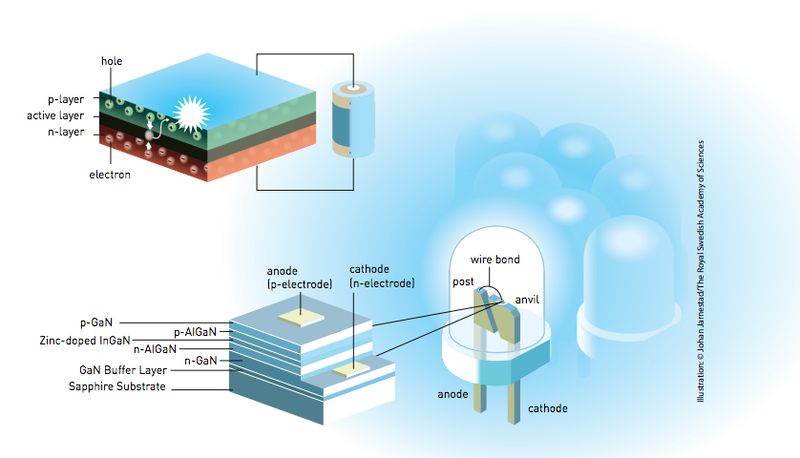
The 2014 Nobel Prize in physics was awarded to Isamu Akasaki, Hiroshi Amano and Shuji Nakamura — three scientists who helped develop blue light-emitting diodes, or LEDs, in the early 1990s.

So why did the Nobel committee think LED lights are such a big deal? In part, they said, because of the technology's potential to change the world: "The LED lamp holds great promise for increasing the quality of life for over 1.5 billion people around the world who lack access to electricity grids: due to low power requirements it can be powered by cheap local solar power."

One big virtue of LEDs is that they're roughly 15 times more efficient than regular bulbs — and they keep improving at a remarkable clip. If they continue to get cheaper, they could replace fluorescents and incandescent lights in places like the United States and Europe, potentially cutting down on a major source of energy use and helping to tackle global warming (although it's also possible that, if lighting gets more efficient, we could just end up using more of it).

So how important are LEDs, really? Here's an overview:

A short history of LEDs
LEDs are often viewed as the next generation of lighting technology. First we had fire. Then gaslight in the 19th century. Then Thomas Edison developed his filament bulbs. More recently, we've had the fluorescent and compact fluorescent bulbs most people now have in their offices and homes.
Those innovations all helped us get more and more lighting with less and less energy. The cost of providing a given amount of light has dropped 3,000-fold since the early 1800s.

Now LEDs look more promising still, since they use less energy and don't contain harmful mercury, like fluorescent bulbs do. But it wasn't always obvious that LEDs would be the next step. Back in the 1980s, diodes could still only emit red or green light, which isn't very handy for lighting a room. But in the 1990s, Nakamura helped develop the first high-brightness blue LED — building on the work of Akasaki and Amano in Japan. Now it was conceivable that LEDs could be used for everyday purposes.
Since then, LEDs have advanced further and become used for an array of different sources. They're in streetlights and traffic lights. They're used for displays in computers and smartphones. But the big, idealistic hope is that they could help bring light to the 1.5 billion people who don't have it.

How LEDs could help light up the developing world

It's worth remembering that there are about 1.2 billion people in the world who still lack access to electricity. And many people who do have electricity barely have enough power for reliable lighting.


As a result, many households still burn either wood or gas for lighting. Not only is that inefficient, but the resulting indoor air pollution is killing millions and millions of people. Plus there are all sorts of knock-on effects — it's much harder for kids to study for school if they can't even read their books.

Now enter LEDs. One big thing these lights have going for them is efficiency. Incandescent lightbulbs are extremely inefficient — it takes a lot of energy to heat up the filament inside, and only a fraction (2 percent or so) of that energy is given off as light. LEDs do considerably better. Engineers can now get about 300 lumens of light from the most advanced LED bulbs for every Watt of electrical power used — compared to just 70 lumens from a compact fluorescent bulb and just 16 for a filament bulb.

In other words, LEDs are about 4 times as efficient as CFLs and 15 times as efficient as filament bulbs. As Charles Kenny explained in Foreign Policy, those low energy demands for LEDs mean that many households that aren't currently connected to the grid could use solar panels and small batteries to power LED lights.

The biggest obstacle is cost: LEDs often have a higher upfront price tag than other types of light bulbs. But that price has been steadily falling over time, to the point where we could start to see wider adoption in poorer countries. (The other advantages? LEDs last longer than compact fluorescent bulbs, they don't break as easily, and they don't contain mercury — so they're easier to dispose.)

Could LEDs help tackle global warming?

The other big potential application for LEDs is in the developed world. It's worth remembering that lighting is a massive source of energy use — it makes up about 17 percent of US electricity consumption.
In theory, LEDs could help change that. Most plans to boost energy efficiency and reduce greenhouse-gas emissions in the United States and Europe envision LEDs replacing all existing lighting technologies by 2050 or so. (See, for instance, this recent UN report on "deep decarbonization.")

The one hitch, however, is what's known as the "rebound effect." Historically, as lighting has gotten cheaper, we've used more and more of it — so that overall energy use for lighting has actually gone up, not down. That's one big consideration here. LEDs could well bolster lighting efficiency and leave us all better off. But it's not guaranteed that energy use — and greenhouse-gas emissions — will go down as a result.

Update: See also my colleague Tim Lee's post on the amazing efficiency progress that LEDs have made over the years. It includes this chart:

THE INVENTORS OF EFFICIENT BLUE LED'S..

SOURCE : a paper from the university of wisconsin

Thank You friends... FoR rEaDiNg My ArTiCle - Bharath Kumar Goud


Monday, 29 September 2014

HOWRAH BRIDGE- Without nuts and bolts


How about visiting a vintage bridge which has no nuts & bolts in its construction but still standing tall for the last 66 years? Hard to believe? The Bridge in concern - one of the busiest in the world - is located at Howrah in West Bengal. The Howrah bridge, the sixth longest of its type, has been an emblem of the city of Kolkata from its inception. So much so that the world knows Kolkata by its trams, the Victoria Memorial, and of course the Howrah Bridge. Opened to traffic in 1943, the construction of the bridge was started in 1937. The bridge has remained one of the most renowned landmarks of Kolkata. More than 150,000 vehicles and 4,000,000 pedestrians cross over the bridge every day. Technically speaking, Howrah Bridge is a "Cantilever Truss" bridge, constructed entirely by riveting, without nuts or bolts!

The present bridge, initially named the “New Howrah Bridge” was built between 1937 and 1943. On June 14, 1965 it was rechristened to Rabindra Setu, after the first Indian Nobel laureate Rabindranath Tagore. The bridge is exposed to traffic 24 hours a day except for Inter- State transport buses, goods vehicles, and All India Tourist buses. At night, only three wheelers and goods vehicles are allowed to pass. To monitor deck level traffic and the same along the river, CCTV is being used.

Notable features of the Howrah Bridge:


705 meters in length, 97 feet in width, 82 meters in height
26,500 plus mega tonne of high-tensile steel was used
Suspension type Balanced Cantilever
325 ft, length of each anchor arm
468 ft, length of each Cantilever arm
564 ft, suspended span
Deck width 71 ft, footpath 15 feet on either side
No nuts & bolts
Total 8 articulation joints, 3 at each of the cantilever arms, and 2 in the suspended portions
Carriageway Minimum headroom is 5.8 m
River traffic freeboard is 8.8 m
Ranks sixth in World’s top 10 longest Cantilever bridges

So what does a civil engineer do, exactly?


When we think of famous civil engineers from the past, we think of Isambard Kingdom Brunel and Joseph Bazalgette, the great engineer of the Victorian age who saved London from cholera by constructing new sewers.

Nowadays, we associate civil engineering with the world's most jaw-dropping structures, such as Sydney Opera House, the Shard and China's Jiaozhou Bay bridge.

But civil engineering is also about maintaining and adapting the infrastructure that we depend on every day – our roads, railways and bridges; energy and water supply; waste networks and flood defences. Civil engineers have to keep this infrastructure running effectively and adapt it to meet challenges, such as population growth, climate change and natural disasters.

They must also find ways to deliver the infrastructure needed when there's little money in the pot to pay for it. Put simply, civil engineers have to come up with solutions to complex problems and implement them; they literally shape the world we live in.

There are many different specialisms within civil engineering, including environmental, structural, municipal, transport and geotechnical.

There are two types of civil engineering roles within the various specialisms: consultants who focus on design work and generally spend more time in the office or working with clients, and contractors who are more involved with keeping an eye on the physical construction and are usually based on-site. Both challenging environments, and all civil engineers are required to be innovative and logical individuals. Other essential attributes civil engineers need include: creativity, versatility, a problem-solving mind, and the ability to understand the bigger picture and to collaborate with a number of other professionals.

Enjoying and understanding maths and science at GCSE level is a great way to get you on the right path to becoming a civil engineer. After GCSEs there are several paths; the most common is to study for A-levels (or Scottish highers), with maths and physics as the core subjects. The third and/or fourth A-level is more flexible, with typical choices being further maths, design technology, chemistry, geography or a modern foreign language. The next stage would be applying to university to get onto an accredited civil engineering course, which is recognised by the Institution of Civil Engineers (ICE).

After university, most graduates join a graduate programme – at a small or large firm – and work their way up the ladder. The application process varies from company to company, but it generally pays to apply early. Many courses offer the opportunity to spend a year in industry, and this may lead to the offer of a graduate role. If not, it's possible to find a summer placement or a work-shadowing opportunity.

Some students decide to follow vocational courses after GCSEs. BTec qualifications in civil engineering are a tried and tested route to becoming a civil engineer, and can be taken either as part of an apprenticeship scheme or as a full-time college course. From BTec level 3, you can progress to a higher national diploma, a foundation degree in civil engineering or a university degree.

Students interested in an apprenticeship can train as a civil engineering technician; usually on an advanced technical apprenticeship. From here, there's also progression to a level 5 higher apprenticeship and then a degree.

After gaining a qualification, the next step is to become professionally qualified as a chartered engineer (CEng), incorporated engineer (IEng) or engineering technician (EngTech). This will involve a period working in the industry to build experience, followed by a professional review.

Saturday, 27 September 2014

How to make stronger, 'greener' cement: New formula could cut greenhouse-gas emissions

Concrete is the world's most-used construction material, and a leading contributor to global warming, producing as much as one-tenth of industry-generated greenhouse-gas emissions. Now a new study suggests a way in which those emissions could be reduced by more than half -- and the result would be a stronger, more durable material.
The findings come from the most detailed molecular analysis yet of the complex structure of concrete, which is a mixture of sand, gravel, water, and cement. Cement is made by cooking calcium-rich material, usually limestone, with silica-rich material -- typically clay -- at temperatures of 1,500 degrees Celsius, yielding a hard mass called "clinker." This is then ground up into a powder. The decarbonation of limestone, and the heating of cement, are responsible for most of the material's greenhouse-gas output.
The new analysis suggests that reducing the ratio of calcium to silicate would not only cut those emissions, but would actually produce better, stronger concrete. These findings are described in the journal Nature Communications by MIT senior research scientist Roland Pellenq; professors Krystyn Van Vliet, Franz-Josef Ulm, Sidney Yip, and Markus Buehler; and eight co-authors at MIT and at CNRS in Marseille, France.
"Cement is the most-used material on the planet," Pellenq says, noting that its present usage is estimated to be three times that of steel. "There's no other solution to sheltering mankind in a durable way -- turning liquid into stone in 10 hours, easily, at room temperature. That's the magic of cement."
In conventional cements, Pellenq explains, the calcium-to-silica ratio ranges anywhere from about 1.2 to 2.2, with 1.7 accepted as the standard. But the resulting molecular structures have never been compared in detail. Pellenq and his colleagues built a database of all these chemical formulations, finding that the optimum mixture was not the one typically used today, but rather a ratio of about 1.5.
As the ratio varies, he says, the molecular structure of the hardened material progresses from a tightly ordered crystalline structure to a disordered glassy structure. They found the ratio of 1.5 parts calcium for every one part silica to be "a magical ratio," Pellenq says, because at that point the material can achieve "two times the resistance of normal cement, in mechanical resistance to fracture, with some molecular-scale design."
The findings, Pellenq adds, were "validated against a large body of experimental data." Since emissions related to concrete production are estimated to represent 5 to 10 percent of industrial greenhouse-gas emissions, he says, "any reduction in calcium content in the cement mix will have an impact on the CO2." In fact, he says, the reduction in carbon emissions could be as much as 60 percent.
In addition to the overall improvement in mechanical strength, Pellenq says, because the material would be more glassy and less crystalline, there would be "no residual stresses in the material, so it would be more fracture-resistant."
The work is the culmination of five years of research by a collaborative team from MIT and CNRS, where Pellenq is research director. The two institutions have a joint laboratory at MIT called the Multi-Scale Materials Science for Energy and Environment, run by Pellenq and Ulm, who is director of MIT's Concrete Sustainability Hub, and hosted by the MIT Energy Initiative.
Because of its improved resistance to mechanical stress, Pellenq says the revised formulation could be of particular interest to the oil and gas industries, where cement around well casings is crucial to preventing leakage and blowouts. "More resistant cement certainly is something they would consider," Pellenq says.
So far, the work has remained at the molecular level of analysis, he says. "Next, we have to make sure these nanoscale properties translate to the mesoscale" -- that is, to the engineering scale of applications for infrastructure, housing, and other uses.

Story Source:
The above story is based on materials provided by Massachusetts Institute of Technology. The original article was written by David L. Chandler. Note: Materials may be edited for content and length.